hello everyone,
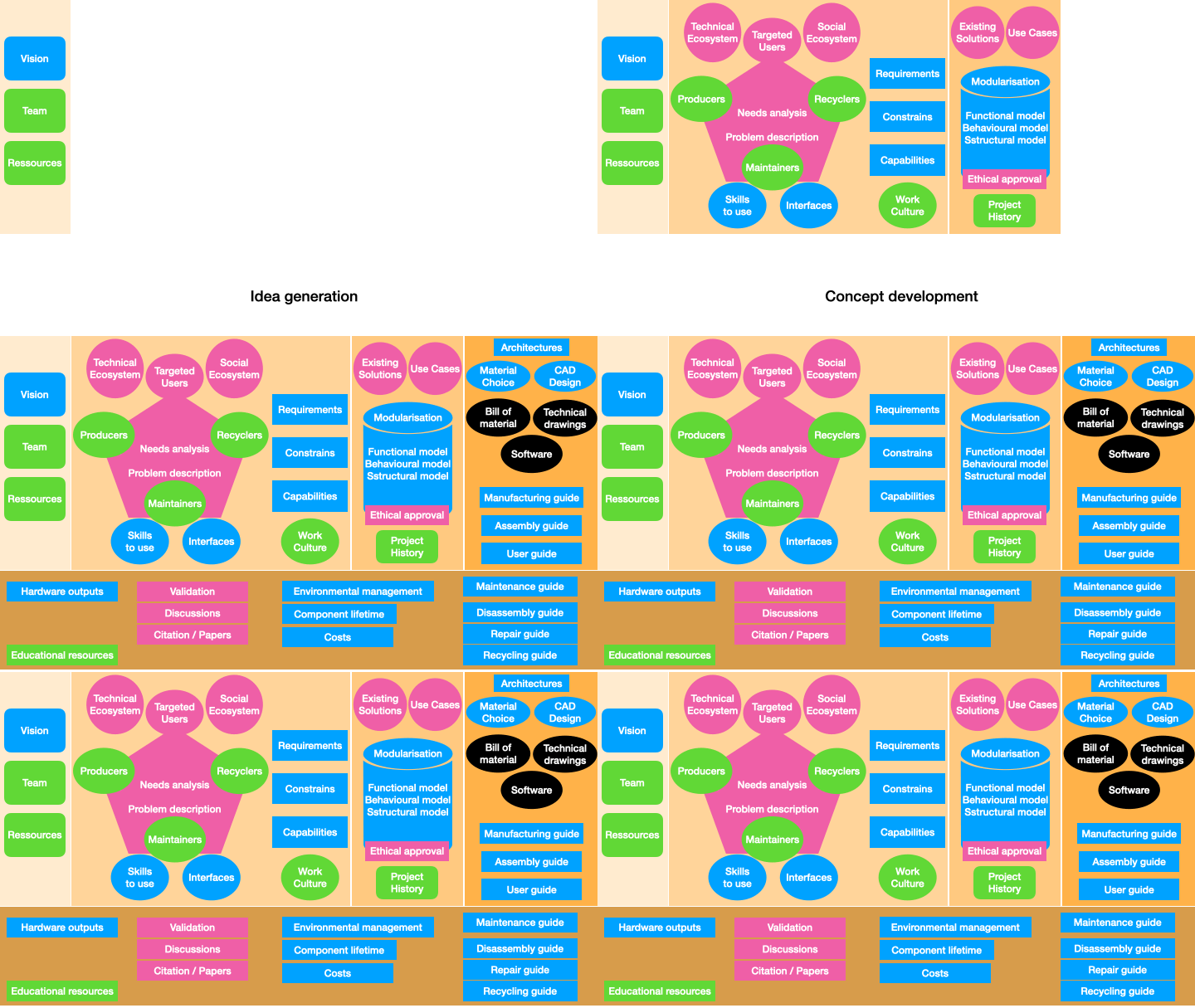
The open hardware documentation guide* has been updated with more sources and is visible at Hardware documentation Guide, please have a look and give me feedback. If anyone wants to be more involved, do not hesitate to reach out.
Here the animated gif as summary: see the book for a caption
Superbe! The work is progressing nicely. I am curious to see if this template can be helpful and follow the implementation in some projects! Cheers, JF
I saved it! A lot of work put together, thanks for sharing I’ll look into it with deeper attention later but I like the point around community building as part of the documentation. Accurate - and timely. À plus!
My first impression is that this goes well beyond the scope of hardware documentation. I see this as a guide to documentation of what we call an “open venture”. We’ve develop this pretty well, within the context of real open source hardware development projects, which are actually more than projects, since they have an economic model attached to them, they include multiple contributors, multiple stakeholders and plan for continuity. If you want to see a good example of that take a look here
You’ll find there an ecosystem of documents that cover not all, but almost the guide that you propose.
Furthermore, these open ventures also ce with tools for stewarding the economic activity around the deliverable, capturing a lot of granular information about contributors, their contributions.
There’s more info about open ventures and you can find templates for the docs we use, analyze them and compare with your guide here
You can feed them to an AI agent to do the analysis and comparison to save you time
But I do find your guide interesting for its structure and detail. I can help you refine it… If we don’t agree, I can fork it can develop it further to match our current needs. These deeds are defined by two infrastructure projects to support peer production.
I wonder if you want to collaborate with us. Part of your work can find very practical applications through Sensorica and spread through the infrastructure for peer production that we’re developing.
will look more into it later, thanks for sharing, it looks very relevant. I love the “Shareable by Default: Resources are designed for sharing and collaborative improvement” part already !
The point is that hardware documentation needs to go beyond the scope of “hardware documentation” as for example defined by the DIN-spec 3105. It seems that is something you realised too: collaborative work requires more than 3D design files in its native format.
I would really loved to collaborate, I would guess the easier would be to start opening issues on the codeberg page? I see already that some business aspects (collaboration with industry partners is different from collaboration with contributors) and infos on non-digital assets (parties, events,…) are missing from my template. You can of course fork if you want to move it in another direction later, it is CC-BY licensed .
So thank you for the link, it is really an interesting resource. I wondered why there seems to be a large French community on the site, before I realised you were in canada :).
The link ..help/venture-help does unfortunately not resolve. the link to old website also gives a 404 page. Can you check and send me a new link?
PS: It seems the whole collaborative system seems based on google toolkits, quite dangerous in terms of longevity. You should at least consider having snapshots on zenodo to ensure long term archival of the documentation.
The cookie banner is less of my taste, probably illegal in EU too. google cookies are not “necessary cookies” and I should be able to opt out.
Right, our digital space for collaboration is still made of Google services. It’s not easy nor cheap to develop proper environments for collaborative work, something that satisfies p2p principles. Having said that, with TrueCommons we are building a new IT infrastructure, which is serverless, self-hosted, so we’ll finally move out of Google. Moving out of a box to go into another box, not worth the migration effort. But moving into a p2p stigmergic environment, YES
Cool, we can collaborate from a distance through our repositories, Github for example, or closer, using Sensorica’s Discord or this Forum, we can get even closer by working together in docs and such.
For the website, we did some restructuring and some links don’t work anymore. Use the search tool to find it. For example in this case search for “help venture”. With time these broken links will be fixed…
Hi, Hardware documentation is part of the process. Design collaboration is another story. Extensive research has been carried out since 30 years on this topic in the engineering design community. I recommend looking into the concept of Boundary Object or Design Intermediary Objects.
Lee, Charlotte P. « Boundary Negotiating Artifacts: Unbinding the Routine of Boundary Objects and Embracing Chaos in Collaborative Work ». Computer Supported Cooperative Work 16, no 3 (2007): 307‑39. https://doi.org/10.1007/s10606-007-9044-5.
Boujut, J F, et E Blanco. « Intermediary objects as a means to foster co-operation in engineering design ». Computer Supported Cooperative Work 12, no 2 (2003): 205‑19. https://doi.org/10.1023/A:1023980212097.

 .
.