last months I been collaborating with my friend Abao, who is really into self-made artistic DSSC (die sensitized solar cells), some of you might have seen his workshop at Open Hardware Summit.
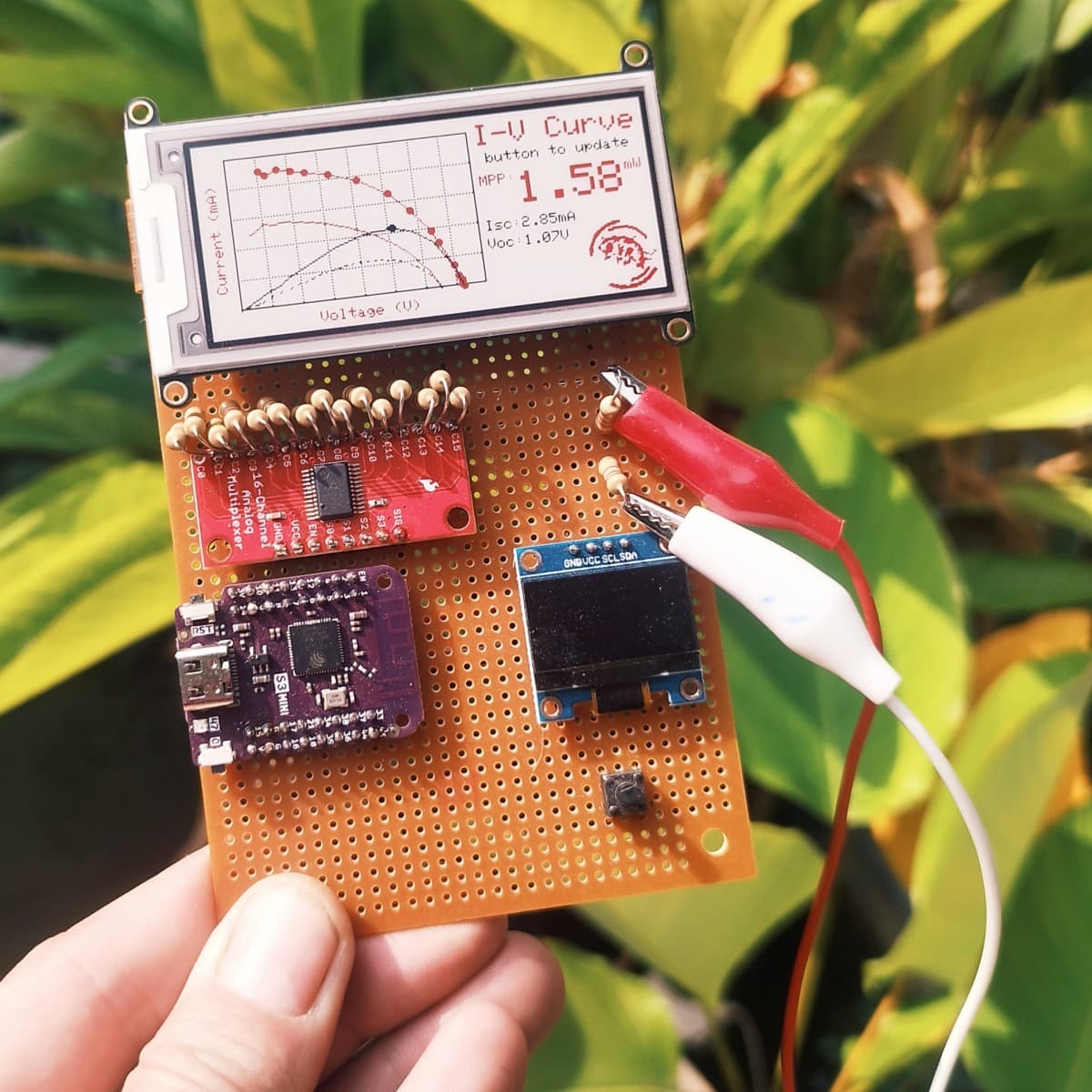
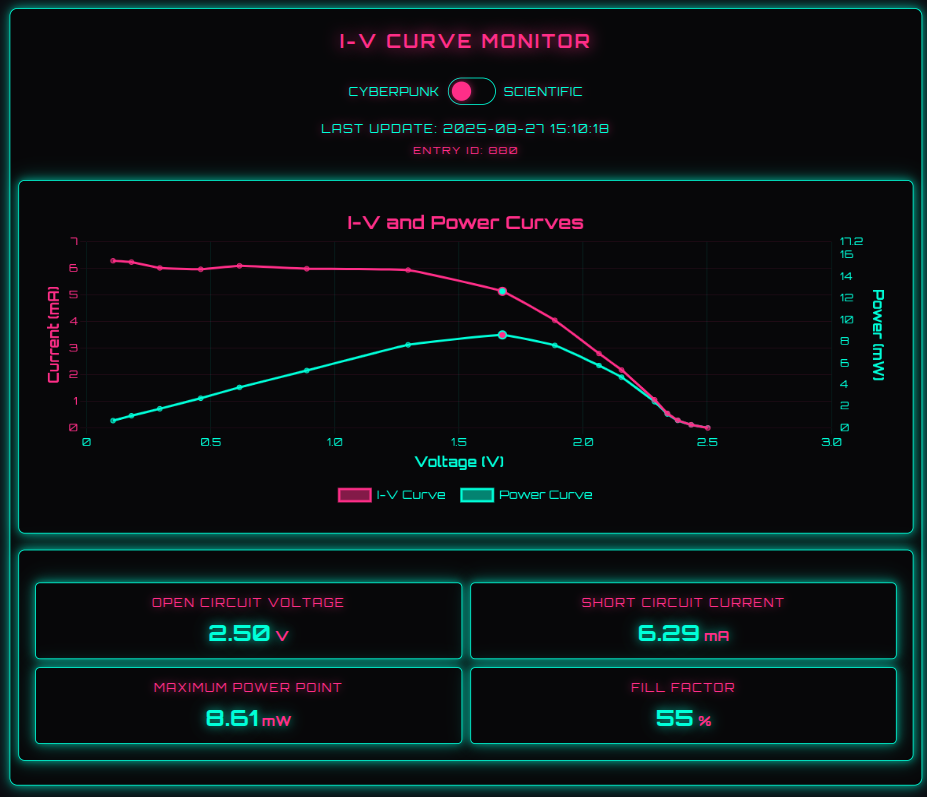
We also developed a little analytical device, an I-V curve scanner (see github). We just switching through different loads (aka resistors) and measure voltage (V) on the solar cell, calculate the current (I), display it on an OLED screen and also on an e-ink display, upload to thingspeak, and draw a curve online e.g. here: https://i-v-curve-monitor.onrender.com/
As we are running the current loads through some resistors and through a multiplexer, it’s not usueful for larger power “real” solar cells, due to too large currents. but the small ones, or other DIY sources of electricity (coconut) can be measured with this tool.
we still in testing phase, a few prototypes built on protoboards. and now considering designing a dedicated PCB for it and get it assembled.
So i am asking here if other people are interested to get one, test their own ideas with it and help to develop this further.
Hi I am collaborating with Marc and using I-V curve as hash value for smart contract by patterned dye sensitized solar cell, using the pattern as “nature defect”.
Hope to get some feedbacks here
somehow I can’t leave links here yet maybe I’m new here.
Hello and welcome to the GOSH Forum! I just sent you a DM, and am happy to help you share links if you wanted to send them my way. Glad to have you aboard!
Very interesting project. I worked on Perovskite SC but not DSSC. Does this device only outputs one figure. Let’s say I wanna do a current or voltage sweep. what output will l get? Also, did you do any publication related to this device?
We run it through different loads (resistors) and measure the voltage, then calculate the current. we had some other ideas with a bunch of op-amps to make a current sink, but stuck with this array of resistors, it’s also kinda educational and obvious what happens with our method.
it’s not really for a peer review publication, but an open hardware DIY project published on our wiki and github open for collaboration and feedback.
I can probably make some useful suggestions on the core circuitry if I know more about the desired range of currents and voltages, probably with an active load.
I found this high speed IV curve meter for weak power device (10pa to 1.5mA, 500k/s). The software interface seems written only in Chinese, and it only runs on PC, but it’s a good reference for cheap product. They open the protocol in this weird Chian cloud drive below.
Thanks for the reply. The motivation was to design a DIY IV curve meter to measure the DIY dye sensitized solar cell of mine, it usually comes with only 0.06W, 3x3 cm, 0.1V to 15V, 0.01mA to 30mA maximum.
I am designing a system to use DSSC as physical unclonable function (PUF), and IV curve is a crucial characteristic of it.
Here is an intro page with LLM can answer more about the project: