Name of applicant(s): David J. Castillo / Waleeha Gudiño (Project leader)
Glyxon Biolabs Mexico City. Mexico.
Email Address: glyxonbiolabs@gmail.com
What track are you applying to?
Established Project Track
Tell us about your project in one or two sentences:
We have successfully built a functional prototype of an automated chromatography machine that simplifies the processing required to obtain isolated recombinant proteins, in addition the automated fraction collector robotic system can be reconfigurable for applications like crops phenotyping and tissue sorting, integrating readily available object recognition cameras and algorithms.
Please describe your project goals and how you expect to achieve them:
Chromatography is one of the most ubiquitous techniques in biotechnology used for purifying biomolecules of medical and economic interest. Nevertheless, affordable and accesible automated chromatography systems are limited due to their operational costs and advanced level of technical expertise. Our prototype facilitates the access and the training required for isolating highly added value biomolecules.
These tools have a very powerful and transformative impact on biomarkers, citizen’s science communities, and virtually any given scientist that needs access to bio reagents, e.g. : Restriction enzymes, nucleases, polymerases, antibodies or any other molecular reagents of biological origin. Our system can also help to the determination of phenotypic information from selected crops. There are different scenarios in which a potential user will require expeditious access to any of the bio-reagents or biomaterials mentioned above: 1) Barriers to commercially distributed enzymes, 2) Remote location of the venue where experimental procedures are required, 3) Intrinsic costs and additional fares associated to importation, transportation or distribution of chromatography generated bioreagents.
While the majority of the potential users will be located in urban contexts and will adapt their learned skills and equipment to their specific needs regardless of their social or economic circumstances, some of the de facto advantages of these tools could enable scientists on the field studying complex ecosystem in remote locations, or even facilitate space exploration. Space exploration will definitely require an affordable, portable system to produce and isolated enzymes of industrial importance, medical tests, medicines, plants and food during long haul journeys and while terraforming other planets or recovering ours.
The first goal is to facilitate potential users the acquisition of bioprocessing skills and tools for downstream bioprocessing capabilities.
Enhanced chromatography system: Our robot prototype can be used as an affordable HPLC system and as a tissue sorting system, including plants.
Hands-on instructional videos on bioprocessing: We intend to produce prerecorded workshops that will facilitate the acquisition of a set of skills that any potential user will need during the experimental design and construction of tools associated to bioprocessing. These workshops and the online materials will focus on the fabrication of a automated machine committed to the isolation and purification of biological reagents (chromatography system). In addition, some basic concepts regarding modular cloning (MoClo), and further systems of genetic engineering (golden braid, NGS, etc) will be superficially covered through informative videos, with the intention that the user becomes familiarized with genetic engineering tools commonly implemented in a broad range of models including microorganisms, fungi, plants and animal cells. Although the working models used will be centered in the assembly of the robotic systems and the biochemical techniques used during the purification of recombinant proteins from non-pathogenic domesticated bacterial strains and the isolation and study of genetically modified plants (corn, tomato, coniferous plants) and their plasmids.
Technology transfer repository: The enhanced prototype will be accompanied with prerecorded “workshops” videos and an online repository that will incorporate the basic information and material containing the instructions for building an affordable chromatography system and the biochemical protocols used to purify recombinant proteins and characterize genetically modified plants by using easy to find reagents available at local stores and drugstores.
Remote sensing tools and tissue sorting capabilities:
The robotic fraction collector could be repurposed to act as controlled environmental chamber that could replicate different climates that are impacted by global warming changes (temperature, humidity, variations in sunlight exposure, etc.) acting as both an incubator chamber for plants coupled with a robotic multispectral sensor that would be capable of measuring physiological changes and photosynthesis performance in intact and photosynthetically enhanced, genetically modified plants.
Advantages of our system:
A) Lower costs using additive manufacturing e.g. 3D printing, laser cutting, 			     simplified design, open access distribution.

B) Creation of a global repository for the access to the system construction 			including blueprints, 3D printed pieces, building instructions etc.

C) Open access operation software

D) Open community and volunteers for sharing and simplifying purification and 			isolation protocols using affordable reagents that can be obtained in regular 			stores, drugstores, pantries or OTC (over the counter)

E) Dedicated, easy to operate graphical interface that simplify the operations 			using a “icon coding” menu

F) Active forum and repository for sharing isolation protocols, technical advice 			and materials, Prerecorded videos explaining the construction and operation of 			the chromatography system/ sorting robot in different applications and scenarios.

G) Dedicated affordable PCB board that can me complemented using consumer 			electronics microcontrollers (e.g. Arduino, Raspberry Pi, etc.)

H) DIY Multispectral sensor for measuring  photosynthesis performance

I) Custom made environmental chamber for assessing plant growth that mimics 			environmentally perturbed ecosystems.
Approximately how many people would be working on your project:
3-9 core members. They also comprise very diverse demographics:
1 Plant Biologist (PhD, Project leader, Female, Latin America)
1 Populations ecologist (PhD, Female, Latin America)
1 Molecular Biophysicist (PhD, Male, Latin America)
1 Molecular Biologist (MSc, Male, Europe)
3 Automation and systems engineers
(Bs & MSc, Male, East Europe and North America)
2 Mechatronics and robotics students
(Bs and MSc, Male, Asia pacific and Latin America)
Describe how your organization will create and manage collaboration with others: We have established a periodical participation at community biotechnology venues where we have presented out results, those include the yearly editions of the MIT Biosummit (from 2020, 2021) and JOGL-The Covid 19 initiative, meetings and online talks. We will continue our presence in those summits and meetings to promote our work. We have an active participation on Slack channels (Glyxon Biolabs) and we plan to reach more user by uploading content to Github; our Glyxon’s website (under remodelation) and You Tube Channel (The Quantum minute). Eventually more formal publications will be considered submission in open access journals like BioArxiv and Make mag. For continuous interactions with the global community we will set up channels over Twitter and Whatsapp for informing about our activities, through flash messages and reels.
Does your project have representation for a marginalized demographic due to factors such as race, ability, place of birth, gender, sexual orientation, socioeconomic class situation, or other identification? If so, how?
Our team is a diverse, multidisciplinary composed of individuals coming from different backgrounds and geographical regions including: East Europe, North America , Asia Pacific and Latin America. At the same time, our collaborators and volunteers are globally represented with the leading participation of women in STEM areas (specialists in Plants biology, Industrial design and Populations genomics). We are actively seeking the incorporation of new other members of biomarkers and scientific communities regardless of their social, economical strata, age, cultural, racial or gender identities.
What resources/infrastructure do you currently have to support your project?
Our facilities incorporates a 32m2 biolab with all the essential tools and reagents for bacterial culture manipulation, plants tissue culture and molecular biology and cloning techniques. The current equipment includes, but is not limited to:
2 Laminar flow hoods (class I and class II), incubators for bacterial strains (1), Thermocyclers (2), pipettes and fluid handling (20+), autoclaves (2), freezers, dry baths (2), programmable magnetic hotplates (3), Protein and nucleic acids electrophoresis chambers (4), (1) Realtime quantitative PCRs machine, (1) spectrophotometer, (2) optical microscopes, and multiple reagents and growth media.
Our biomedical personnel are highly skilled, specialty trained professional scientists with international certifications and experience at leading research institutions including The Smithsonian Institute, The Max Planck Institute, Waseda University, Arizona State University, UNAM and ITESO.
We have to our disposal 25m2 fab-lab workshop include (2) fused filament 3D printers, circular saw, handheld drills, heated blowers, jig saws, working benches, oscilloscopes, CNC routers. We also have access to laser cutting services and reliable providers of extruded aluminium material, electronic sensors, and additional materials.
Our automation and systems engineers are highly trained personnel with specialty experience in leading IT companies including Microsoft and consumers banking, customized electronics design, and arts installations.
We also have access to video and audio edition equipment (digital SRL cameras, audio consoles, external microphones, edition software) for the production of prerecorded multimedia content.
What will you use the funds for? Describe your budget. Please list what you are going to spend it on and how.
The funds will be used to create 2 main prototypes and a protein expression system
The first prototype will help enhance a readily customized designed robotic fraction collector into an automated phenotyping environmental chamber for studying plants photosynthesis using a 12MP CMOS sensor camera, an atmospheric CO2 sensor, a servo controlled gas mixer (Air / CO2) a gripper arm, and a Infrared/NDVI multi lens sensor. All the sensors, actuators and camera will be connected into a dedicated PCB board (existing) and or additional consumer electronics micro controllers (Arduino, Raspberry Pi). The chamber will incorporare a high precision humidity chamber, thermostat, temperature sensor, humidity controller and programmable, wide wavelength LED illumination strips.
A second prototype will incorporate a optical multispectral sensor coupled to the robotic arm gripper. This sensor is based on the MultispeQ Beta (Kuhlgert et al, 2016) This multispectral sensor will study the photosynthesis performance and growth of a genetically modified tomato we have achieved to generate at our lab, vs existing not modified tomato variants. This tomato strain is capable of doubling it growth when bypassing photorespiration.
Protein expression system:
We have previously achieved to clone and purify recombinant DNA polymerases and a Reverse transcriptase using an opto-genetically controlled plasmid that induction is activated after the exposure to blue light. We believe this system helps to reduce the associated costs of using chemical reagents for recombinant protein induction. A second plasmid will be constructed based on the previously designed to capture recombinant protein using a lower cost silica matrix chromatography column instead of using costly commercial, metal based IMAC. Beside the original DNApol and Reverse transcriptase plasmids, we intend to generate two more enzymes that are required in regular molecular biology techniques.
10.- How will you share the outcomes your project? What documentation will you provide so that it will benefit the community as a whole? (videos? photos? a how-to? Every stage on of the project will be documented on our GitHub website, GOSH website, and Glyxon’s website repository. In addition prerecorded informative videos will be available explaining the assembly instruction and applications of the prototype.
11.-How will your project address GOSH’s values of diversity and inclusion?
We have incorporated women with STEM education in leader roles within our organization. In addition the applicability of the project is feasible in remote indigenous communities dedicated to the administration of forestal resources or interested in producing their own bioreagents.
12.- Are there any conflicts of interest that you wish to declare? No conflicts of interest.
- Describe your experimental plan, including any new technologies or tools to be developed.
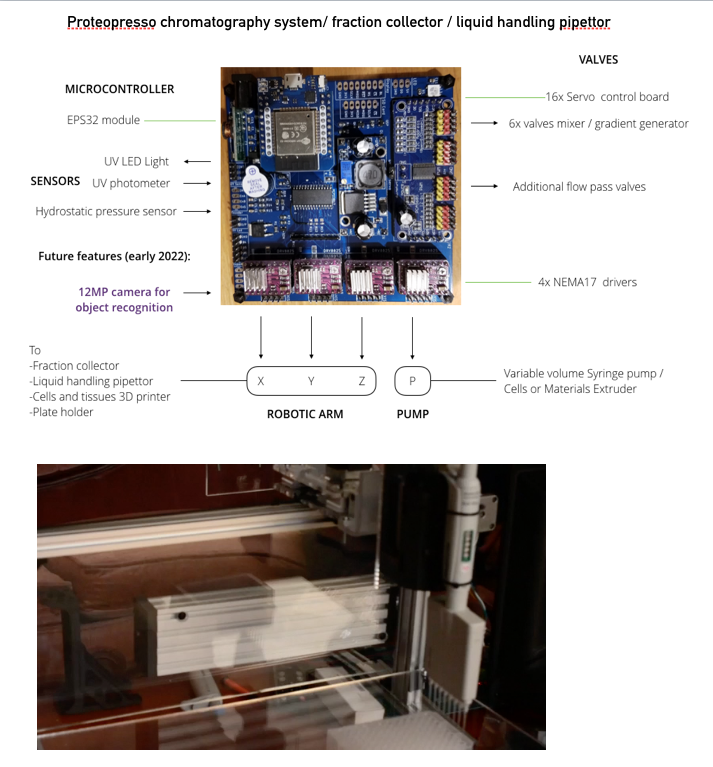
The current integral solution proposed by our project has multiple applications, the automated chromatography system has a robotic arm that can be quickly reconfigured depending on the module attached. It could work as protein fraction collector; a cells and tissue 3D printer; a culture vessel gripper and sorter; and as a pipetting robot (with universal access, regardless of pipettes manufacturer).
The initial goal is to enable the system by coupling two new capabilities: Multispectral sensors for photosynthesis assessment and a programmable environmental chamber. These additions will enormously expand the capabilities of the system beyond the current applications. There is no affordable, automated, bench size solutions in the market or elsewhere for quickly coupling remote sensor technologies in controlled environmental chamber (EnviroPod) for studying the metabolic/genetic performance of genetically modified plants (or further organisms, including humans or mammalian cells). In plants, these physiological assessments, normally require large experimental greenhouses or open crop fields where multiple of other uncontrolled variables could result in unreliable data. With this system, we are confident of having a stiffer control over the important variables that define the performance of newly designed, genetically modified plants or crops challenged by global warming.
How does Proteopresso/EnrivoPod could help the cultivars of the future in a constantly threatened environment?
The Proteopresso/EnvironPod system will be able to emulate the constantly changing environmental variables resulting from global warming by integrating remote data of areas dealing with drought, desertification or perturbed ecosystems. Temperature, substrate moisture, humidity, atmospheric concentration of CO2, etc., will be reproduced into the EnviroPod using remote data from challenged geographies. This eco-physiological integration could offer a detailed successional dynamics of perturbed ecosystems and their temporal variations could also be mimicked. Given that several crops rely on local microclimate for irrigation, aeration, growth, etc., several traditional cultivars are incapable to quickly adapt pacing the changes derived from global warming. This poses a great challenge to either sustain healthy, productive cultivars and forest capturing atmospheric carbon and water recharge. Genetically modified plants with enhanced photorespiration could have a direct impact on faster growth cultivars and rapid atmospheric CO2 capture rates.
For testing that hypothesis we have designed a genetically modified tomato variety that bypasses photorespiration. We would like to test it to several climate conditions and evaluate its photosynthetic performance. The resulting data will allows us to escalate the photorespiration bypass modification to other species that could bring benefits for fighting climate change by forestation and availability of climate resistant crops. The obtained result of this first assessment/application will pave the road to scale up into large coniferous plants species used in reforestation programs. The resulting photorespiration enhanced trees quite likely endure the present climate changes and could alleviate the atmospheric CO2 concentrations.
How does Proteopresso/EnrivoPod provide solutions to further biomedical applications?
Previously, the Proteopresso system has been capable of producing recombinant protein based bioreagents required for testing of COVID19 though PCR (DNA polymerase, Reverse transcriptase). Nevertheless these bioreagents can be easy used for further clinical and phytosanitary diagnosis, that includes HIV, and plagues affecting plant cultivars. In addition the biosynthesis of these important enzymes will be upgraded using a new genetic chasis (expression plasmid): The same optogenetic control will be implemented but a new silica affinity tag will be used to substitute older traditional His-Tag for protein recovery. Two additional recombinant proteins, frequently used in molecular biology techniques will be generated using the plasmid mentioned above
- How will the work you describe be performed within the budget and time period allocated for the initial Phase I award? This should include project work time, ramp up and required reporting.
The development of the EnviroPod and the multispectral sensor module will be completed using the Proteopresso platform (chromatography system) already available. Perhaps the most demanding time will be the waiting time for the providers while ordering additional electronic components. Despite potential delays the module components, the device is expected to be finished within 2-3 moths.
In the case of the new expression system for recombinant proteins. The existing chassis will allow to complete the new plasmids in 3 to 4 weeks after the ordering restriction enzymes and primers. We have access to a local molecular reagent providers and oligo synthesis companies with expeditious services.
In either case, both projects will be completed by July 2022
- What essential milestones will you generate during your Phase I award?
The core system integration press will be a rewarding challenge to complete. The optical recognition system for sorting tissues requires training. A reliable image database will be build from the samples grown on the EnrivoPod.
-
If Phase I is successfully completed, what are the next steps?
Testing on the field with people and organizations interested on testing out our system for the purification of bioreagents and plants phenotyping -
Please include a brief breakdown of allowable direct costs under the following categories: personnel, supplies, subcontracts, travel, and other expenses (equipment).
Blockquote
PERSONNEL: ITEM ESTIMATED COST USD WHY IT’S NEEDED?
Consultants $500 USD Provide feedback on technical feasibility
SUPPLIES: 3D printing materials $200 USD pieces produced by additive manufacture
Electronic components $600 USD Multiespectral sensors requiere electrooptical components
Molecular biology reagents DpNI restriction enzyme $100 USD For subcloning other molecular biology enzymes into new plasmid
Reagents $50 USD Cell lysis
Miniprep kits $50 USD Purification of DNA
Oligo synthesis $300 USD Gene amplification and cloning
SUBCONTRACTS Laser cutting / micro machining $200USD Prototyping Environmetal chamber
TRAVEL Air/land fares $600 USD Transportation of students
OTHER EXPENSES: Parcel, shipping importation fees $400 USD importation of electronic components