Yes, @kaspar, using the STE standard will surely help!
@julianstirling it would be great to have something like the Hemingway App but for STE 
1 Like
I didn’t know about the Hemmingway app, it would really be very good for me as I tend to write really long run on sentences that sort of change topic in the middle an then are talking about me instead of the Hemmingway app unfortunately. 
In all seriousness something that warns for long sentences and complicated words would be great. I would much prefer it to be something that is separately developed that we use. Language check could have been a base, but it is just Python bindings for a Language Tool. Language tool is in Java, I worry that trying this will make GitBuilding harder to install, and we really need to make it easier!
Can anyone suggest web hosting (and possibly email hosting) options?
“Free options”
I’ve used Weebly in the distant past which was fine, but I can’t deal with the endless Wix marketing on youtube so although this platform has been recommended I would rather avoid. In general I’d prefer to ‘pay to own’ rather than use free services without control, although I’m already hooked on gmail sadly.
“Website email hosting options”
Our plan is to create very simple web content but we ideally need a light and flexible hosting option to get a URL and some email addresses setup.
“Uni hosted”
Other options include hosting within our University system- WordPress sites are available - but this would always be short-term and lacks independence.
“Server real or virtual”
Or setting up server hosted on AWS, which feels too much hassle at this point.
If I knew what to suggest I’d add it directly to the top list, it would come somewhere near marketing and could link to Shop.
Domain
The domain name will never be free, you can get them at reasonable prices from somewhere like namecheap.
Hosting
We use GitLab for OpengFlexure, OpenFlexure Industries, GitBuilding, and I also use it for my homepage.
Pros of GitLab hosting
- Free
- Incredibly simple to set up SSL certificates for HTTPS (i.e. to get the lock symbol)
- Can serve any static HTML site
- Can build the site using a static site builder like Jekyll
- Many users can manage the site with varied controls via GitLab interface
- Website code can optionally be open source
Cons of GitLab hosting
- Can only host static content (couldn’t have a web shop)
- Initial setup can be a bit confusing (must set up DNS records) and get the GitLab CI to build/publish the website
- Doesn’t have a interactive WYSIWYG editing for websites, you either are changing the code on GitLab in the code editor, or editing the website on your own PC and then using Git to push it to GitLab
With mailgun I think you can have a free account at your own domain. You can definitely get email from your own domain forwarded to another address
Brilliant thanks- sounds great advice, and covers my questions. As I assume there are other ‘digital noobs’ out there like me wanting to do this, to summarise it looks like:
- GitLab hosts your project, so why not use it to host your web pages as well?
- can fork an example website from GitLab e.g. list here https://gitlab.com/pages complete with lots of instructions how to use
- for example if using Jekyll aim to use branched version as it allows web pages to be hosted slightly separately from main project code https://gitlab.com/pages/jekyll-branched
- ideally set up your website draft pages on gitlab first, so when you register your domain name you can supply hosting details and get the domain name linked to your pages directly. GitLab offers web page directly via their site so you can avoid domain name registration I think it will look like this https:// username .gitlab.io/ projectname
- fiddle around with loads of stuff to configure it- if, like me this is not something you’ve done before, expect lots of troubleshooting via google… words like pipeline, certificates, CI, are a bit offputting
PROS of domain name registration and hosting with GitLab
- proper way to own your website and proper content
- long-term, stable, not dependent on ‘free’ setup
- portable to other hosting options, you clearly own and control your own content
- hosting on GitLab and tools like Jekyll are widely documented so it’s easy to find “how to” guides
CONS - still quite a lot of work compared to just using ‘free’ setup like Wix/Weebly
- lots of ways to get it wrong (but see comment about extensive web guidance)
(note: very proud I used markdown to create lists - credit to Open Hardware community where I learned to use this… recommend to other digital noobs)
1 Like
I agree, even as someone who is very happy programming I found the first CI I set up rather confusing. I think a “Non-technical guide to GitLab hosting” is really needed.
Hi,
It all depends what you want to do…
Please take a look at this Sensorica page that talks about digital environments.
https://www.sensorica.co/environment
Ask yourself a few questions about the vocation of this website, its function it has within your organisation.
Sensorica is built on Google Sites, free and easy to use. Access is the most important thing for us, it provides anyone access to create content, not just as in having the credentials to do so, but also as in being easy to do so, no need to learn any markup language, not for geeks, …
But again, your question requires some deeper thinking…
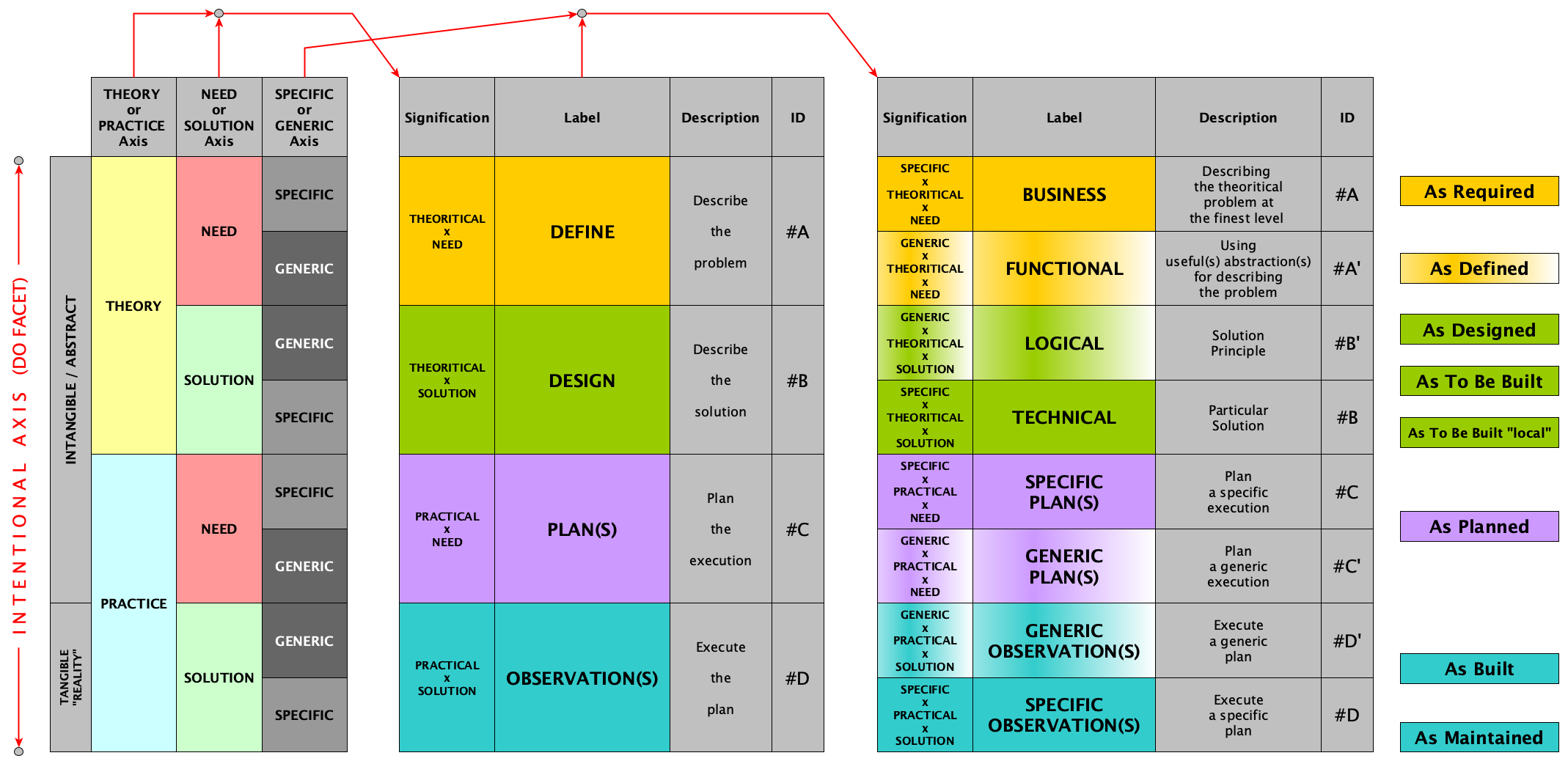
Some product “types” (corresponding in fact at lifecycle “stages”) can NOT be explained by this schema !
Indeed, at the Design level (ID = #B) the product types : As Designed / As To Be Built / As To Be Built “local” need another (or perhaps 2) Axis to be fully explained …
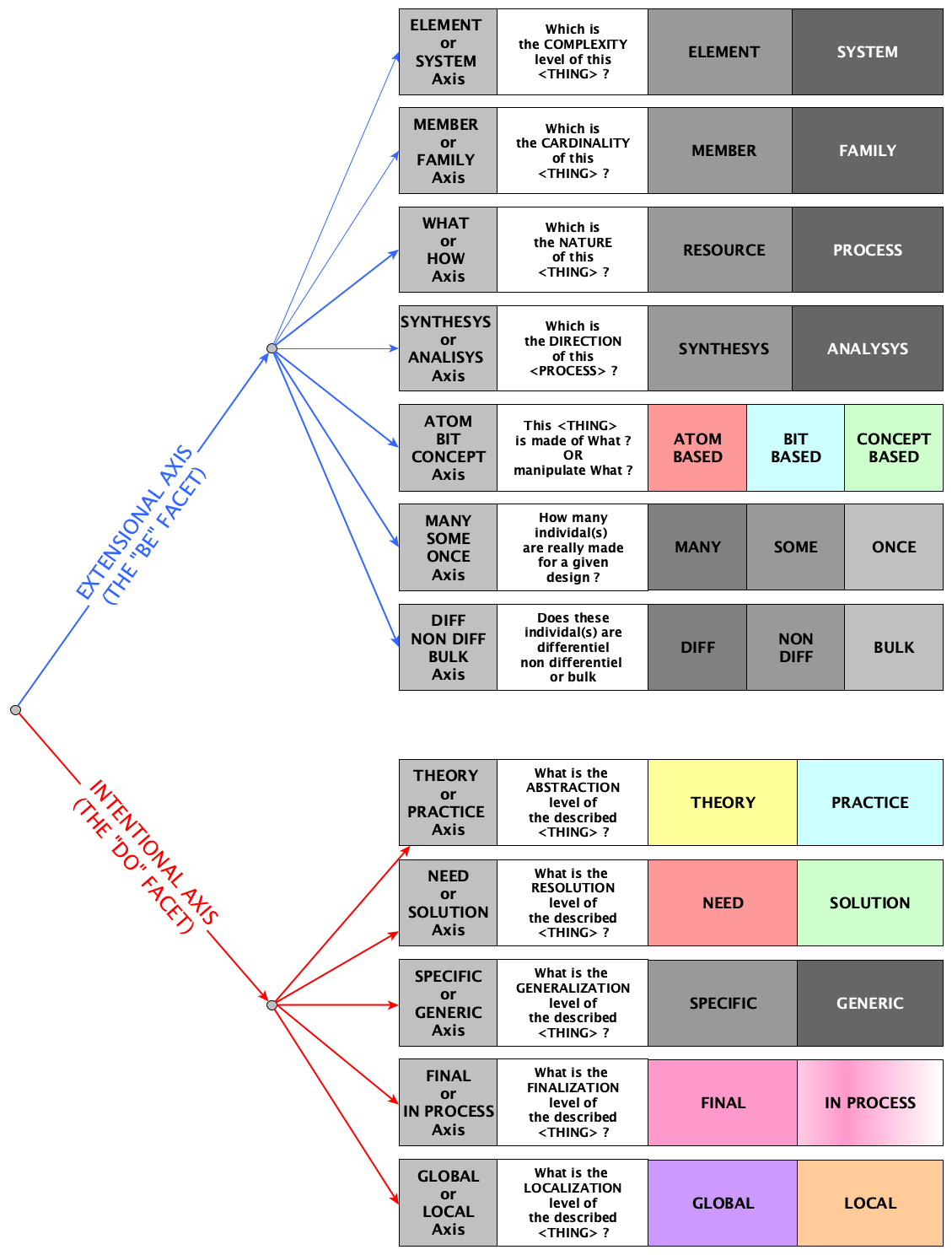
One Axis could be “FINAL” vs “IN PROCESS” in order to explain “As Designed” vs “As To Be Built”
The other Axis could be “GLOBAL” vs “LOCAL” in order to explain “As To Be Built” vs “As To Be Built Local”
So, the xML ( Lifecycle Management) problem require now a « 12 dimensions » - matrix solution with :
• 5 Intentional Axis
• 7 Extensional Axis
=> Size of the theoretical matrix : 2x2x2x2x2 X 2x2x2x2x3x3x3 = 32 X 432 = 13824 cells
(Rq : Some “cells” of the matrix are N/A)
@iPlumb3r Could you add more context to these answers? I do not follow the information presented.
Hi @julianstrirling
I’m very sorry, but a schema is missing !
As I’m a newcomer in the forum I can NOT add 2 schema in the same post AND I can NOT post more than 3 posts in a row 
So I have planned to post the missing schema tomorrow 
Hi @julianstrirling
The global context is about the « PLM » (Product Lifecycle Management) knowledge domain
=> defining, designing, developing, producing & maintaining products
(In other words : « All about the Product from the cradle to the coffin »)
The local context is about the different Product « types » (which are in fact lifecycle « stages »)
For exemple we encountered in this knowledge domain the following « stages » :
- As Required Product
- As Defined Product
- As Designed Product
- As To Be Built Product
- …
- As Built Product
The goal of this schema is to provide a « deep explanation » of each « stage »
=> i.e. explaining which combination of more simplest concepts are using in order to give meaning to a given « stage »
For example the « stage » named « As Required Product » take its meaning thanks to the following combination : Theory x Need x Specific
Hope this helps !

